


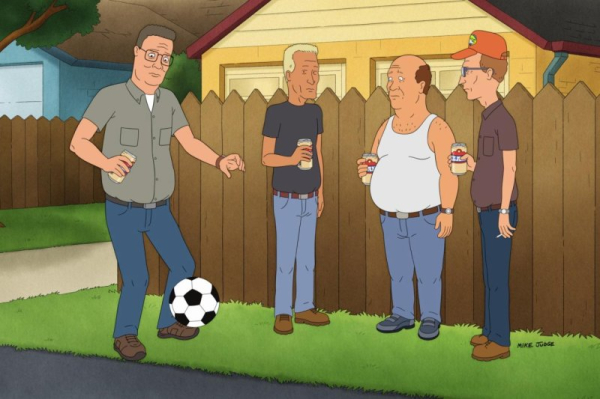
1 of 5 | From left, Hank’s soccer enthusiasm upsets Boomhauer, Bill and Dale in “King of the Hill,” premiering Aug. 4 on Hulu. Photo courtesy of Disney
Mike Judge previously brought Beavis and Butt-Head back to a world that made the pair’s idiocy seem like genius. Now, the King of the Hill revival, on Hulu Aug. 4, uses the Hill family to show the world need not be as divided as it is.
The new episodes see Hank (voice of MIke Judge) and Peggy Hill (Kathy Najimy) return to Arlen, Texas, after living in Saudi Arabia as Hank worked on a propane project. Now retired, they plan to spend quality time with their 21-year-old son, Bobby (Pamela Adlon).
Bobby owns his own restaurant and the staff includes some endearing new characters. Meanwhile, Hank’s neighbors Bill (Stephen Root), Dale (the late Johnny Hardwick and then Toby Huss) and Boomhauer (Judge) have evolved since the Fox series, but still hang out in the yard.
The humor of King of the Hill was always rooted in Hank’s conservative values coming up against the already evolving society of the ’90s. It laughed with Hank and his friends at their confusion at new developments, not at them.
That’s an even trickier balance to strike in 2025, and creators Judge, Greg Daniels and new showrunner Saladin K. Patterson have ensured the series enjoys watching its characters struggle to learn.
Hank is more bewildered than upset by rideshare or all gender bathrooms. The Hills don’t complain about the world being “woke” but Hank is aware of the potential to be canceled.
King of the Hill presents a loving take on folks who might be outdated, but never quite mocks them. The Hills never championed conservative values to belittle or hurt anyone else. It’s just every time they learn that old ways might be harmful, it’s an education.
Hank accepts renaming Samoa cookies as long as the flavor remains. King of the Hill also depicts a friendly environment, as in strangers who share with their neighbors instead of ganging up on minorities.
Task apps appear to be a boon to Hank’s handyman skills, but he struggles with the expectation to make small talk with the customers. When he does, then he is aghast to realize this generation puts everything online.
Hank can be the agent of change too, as seen in an episode in which he shares he actually learned to like soccer while in Saudi Arabia.
Seeing Bobby at 21 raises new issues with young adult dating, when it comes to texting protocols and modern relationship norms. Some of his love interests recur in multiple episodes too.
It also evolves Bobby’s relationship with his father. There are still things Hank wants to teach his son but he can’t order a 21-year-old around like a teenager.
Bobby has affection for his father but recognizes his shortcomings. Peggy is even more needy now that Bobby needs her less, a common empty nest phenomenon.
The series incorporates the show’s catch phrases effectively, but not all at once. It’s not until Episode 3 that Hank makes his famous reference to Bobby. Boomhauer’s gibberish is still funny.
An episode handles cultural appropriation, neither condemning attempts at sensitivity nor calling out appropriation. A Black restaurateur challenges Bobby running a Japanese fusion restaurant, but the characters have sincere interest in other cultures and protecting theirs.
The modern era has only enabled Dale’s conspiracy theories further. His anti-mask stance extends to gas masks and catcher’s masks, and he even considers his own election to mayor a conspiracy.
Pandemic isolation and delivery services have enabled Bill to become even more antisocial.
The new opening titles cover the years between the Fox series and the Hulu revival, as characters grow up and wear masks during a brief period covering the COVID-19 pandemic.
The animation uses simple alterations to acknowledge the time passed. A line or two added to Boomhauer’s face makes him look older, as does Hank’s graying hair.
There is still some plain old cartoon absurdity, such as an episode in which Bobby must care for a horse.
Aging up the King of the Hill characters proves to be the right choice. Showing how characters adjust to changing times while remaining true to themselves is a continuing source of humor.
Fred Topel, who attended film school at Ithaca College, is a UPI entertainment writer based in Los Angeles. He has been a professional film critic since 1999, a Rotten Tomatoes critic since 2001, and a member of the Television Critics Association since 2012 and the Critics Choice Association since 2023. Read more of his work in Entertainment.
