


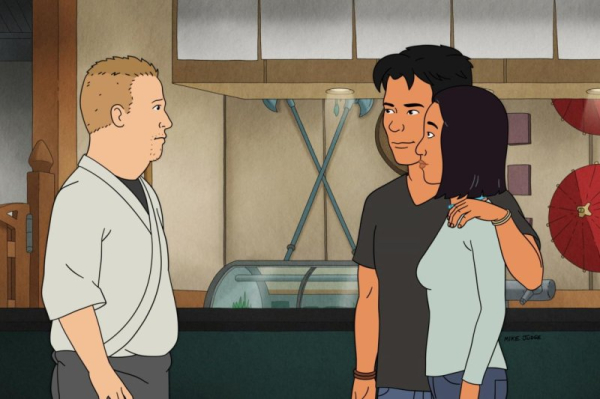
1 of 7 | Bobby learns that Connie and Chane practice ethical nonmonogomy in “King of the Hill,” on Hulu Monday, but he is not ready for it. Photo courtesy of Disney
While it has been 15 years since new episodes of King of the Hill aired on Fox, only nine years have passed for the characters in Season 14, premiering Monday on Hulu. Bobby Hill (voice of Pamela Adlon) is now 21 years old and his parents, Hank (Mike Judge) and Peggy (Kathy Najimy) are retired.
In a recent Zoom interview with UPI, ensemble cast members Lauren Tom and Toby Huss said it was easy to adjust to their characters’ ages. Tom plays Connie, Bobby’s neighbor and classmate in the original series, and a lingering potential love interest.
Tom, 63, shared how Connie is closer in age to her own voice now that the character is in her 20s.
“It was actually harder for me in the beginning to play someone 12,” Tom said. “King of the Hill was my first voiceover job so I did a lot of learning as I went.”
Huss, 58, previously voiced supporting roles like Hank’s father, Cotton. When voice cast member Johnny Hardwick died in 2023, Huss took over Hardwick’s character, conspiracy theorist neighbor Dale Gribble.
Hardwick recorded seven episodes before his death, and the seventh is dedicated to him in the new season. Huss had to add sporadic lines to some of those episodes and aimed for them to blend in seamlessly.
“I didn’t want to change Dale,” Huss said. “I think Johnny and I smoked about the same amount of cigarettes over our lifetime so we both have a good gravelly thing.”
Huss said he focused on specific sounds Hardwick made — as long he could mimic those, he could sound like Dale.
“If you hear it, you’ll go, ‘Okay, that’s the tone of Dale. That’s close enough,'” Hardwick said.
Beyond the voice cast, the show’s animators had to capture the older characters, too. Showrunner Saladin K. Patterson, who executive produces with creators Mike Judge and Greg Daniels, teased that one character has let himself go in the ensuing years, though reverts closer to his original appearance in later episodes.
Otherwise, the changes are subtle. Hank’s hair is grayer. Boomhauer (also Judge) has an extra line in his face.
“We didn’t want it to be a shock,” Patterson said. “We still wanted people to feel like they’re watching people that they always knew and loved.”
Tom also voices Connie’s mother, Minh. A highly competitive socialite who rubs her victories in the Hills’ faces, Minh has lost some of her subtlety in Tom’s new portrayal.
“I like to say that Minh used to be passive-aggressive but now she’s just aggressive,” Tom said. “I think it’s okay that my voice has gotten a little bit lower if you compared this season to the pilot from the ’90s.”
Patterson said the team briefly considered leaving the characters the same as they were in the original series. Judge brought back Beavis and Butt-Head both still as teenagers, and as middle-aged men, thanks to a multiverse story, but King of the Hill could not send the Hills into space to preserve them.
Ultimately, Patterson said, Judge and Daniels decided the passage of time was what justified a revival.
“Why bring it back?” Patterson asked. “Aging the characters up to give them a new chapter and new phase of life that they’re exploring that the fans can experience with them, I think, is a very smart way to answer that ‘why now’ question.”
Dale was always the resident conspiracy theorist, but now finds himself in a present day where everyone has a forum to vent theories. Dale writes a substack but that can hardly compete with TikTok and other platforms.
“Dale is on uneven ground,” Huss said. “His move to the right has been usurped.”
Bobby and Connie’s relationship is complicated by Connie practicing polyamory. She is in a relationship with another character, but both Connie and her boyfriend practice Ethical Nonmonogamy.
“I actually had to ask my kids what ENM stood for,” Tom said. “That’s so progressive and cool for her. It just gives it more conflict rather than just have them get back together easily.”
Modern social phenomena give King of the Hill a lot more episodic stories. Hank may be confused by all gender bathrooms but he is ultimately sensitive to them.
He also acknowledges he does not want to get canceled, though the show avoids using terms like “woke.”
“We have Hank reference cancel culture for sure, but things like wokeness, that term in and of itself has been appropriated and usurped by the political factions that want to weaponize it so much,” Patterson said. “We wanted to stay away from letting our show be weaponized as well.”
Patterson clarified that King of the Hill was never overtly political. Rather, he distinguished, it was “a show that talked about cultural things. There’s a difference.”
Therefore, an episode of the revival addresses cultural appropriation in a King of the Hill way. Bobby is criticized for operating a Japanese fusion restaurant when he is not Japanese, but Patterson defends Bobby’s intentions.
“When people have their own agenda, people project that agenda onto good intentions,” Patterson said. “The comedy comes from Bobby being stuck in the middle in the way that Hank in the original was often stuck in the middle. And Bobby’s trying to say, ‘This is about a celebration of things, not about excluding or appropriating or anything.’ It felt like that was good cultural social commentary.”
