


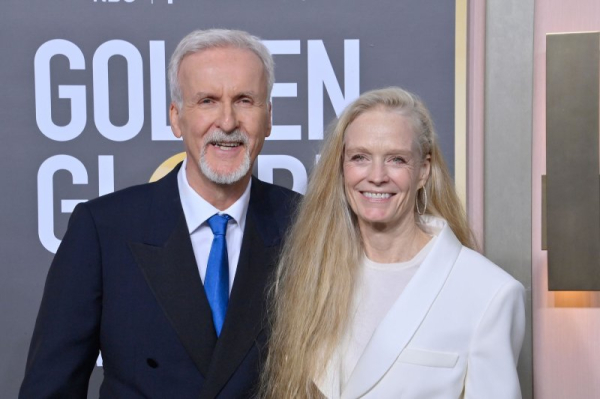
1 of 3 | James Cameron, seen with wife Suzy Amis Cameron at the 2023 Golden Globe Awards in Beverly Hills, Calif., executive produced “Secrets of the Bees.” File Photo by Jim Ruymen/UPI | License Photo
As a filmmaker, James Cameron regrets how badly cinema often portrays scientists. He said he made it a point to show Dr. Grace Augustine (Sigourney Weaver) in Avatar as a passionate scientist.
Furthermore, Cameron found the best way to combat stereotypes of scientists as boring, awkward or even evil characters is to show real scientists. The National Geographic series Secrets of the Bees follows entomologist Dr. Sammy Ramsey.
Cameron and Ramsey spoke after a recent screening of the first episode, which premieres Wednesday on Disney+ and Hulu. Cameron said Ramsey’s enthusiasm for his research makes science engaging.
“Scientists are never very well represented in movies,” Cameron said, adding that Ramsey embodies science as a viable career. “Someone might look at you, Sammy, and say, ‘I want to have that sense of purpose in my life. I want to follow my curiosity and make that my career.'”
Cameron does not expect every viewer to make career decisions based on the series, which is fifth in the Secrets Of series he produced. But, he has considered those extreme cases.
“If you can convince one kid out of 1000 or even 10,000,” Cameron said, “They’re going to go on and they’re going to become the next generation of researchers or anywhere in STEM.”
As the subject of the series, walking host Bertie Gregory through footage of bee colonies from around the world, Ramsey was sensitive about the balance between entertainment and education.
“It’s been very important for me to avoid anything that sensationalizes the science,” Ramsey said. “Sometimes when you sensationalize these things and you leave people with the idea that the apocalypse is right around the corner, they shut down.”
Secrets of the Bees does deal with the declining bee population and the environmental dangers a reduction in pollinators could pose. However, Ramsey also offers solutions as simple as planting more flowers in people’s backyards.
“There are problems but we can fix them,” Ramsey said. “That is really what connects people to the information.”
Involving viewers in the solution was also something Cameron appreciated about Ramsey’s approach to science.
“You’ve got to task people,” Cameron said. “You’ve got to appeal to people’s innate desire to want to do something and to want to be good. I think if you constantly lecture people how bad we are as a species for all the other species, you don’t serve a positive goal.”
That said, Cameron was able to make one sensationally dire prediction should nothing be done to protect pollinating insects. The series explains how losing pollinated vegetation could make corn products the only remaining nutritional source.
People may survive on corn products, but Cameron predicts that won’t be what kills us.
“Our food system is so broken as it is that to add this layer to it, cut off 70% of the biodiversity of nutrition sources that we have is going to lead to massive famine, which is going to lead to wars, which could lead to a nuclear war, and then we all die,” Cameron said.
In addition to his own research, Ramsey teaches science communication at the University of Colorado Boulder. He had already thought about how to communicate science before Secrets of Bees.
“It’s important to break your audience down into pieces and think about who it is that you’re targeting,” Ramsey said. “Sometimes we really want policymakers to make better decisions.”
Ramsey said that he will discuss the economic values of scientific and environmental legislation when he is consulting with lawmakers. For regular viewers, he has broader motives.
“We want each one of you to be excited about what you’re seeing,” Ramsey said. “You can have that interspecies empathy, as I call it, that allows you to recognize what it’s like to be that organism because then you’re a lot more inclined, after you’ve walked a day in their shoes or flown a day in their wings, to protect them.”
The footage of the bees, taken with endoscopic cameras, turns bees into a story. One subplot shows a hive defending itself from hornets.
“People love stories,” Cameron said. “They love narratives. They love protagonists and they’ll walk a mile in the shoes of any human character, even a serial killer or whatever we’ll follow and be interested. And walk a mile in the shoes or the fins or the feet of all of these different animal species.”
Some of the footage allowed Ramsey to see things he’d never witnessed before. They are included in the episodes, such as when a hornet marks a colony with its pheromones, but the bees mask the scent before the hornet can return with its swarm.
“They grab these leaves that are very pungent, chew them up a bit and then rub that over the pheromone so that when the hornets come back, they’re lost,” Ramsey said. “This is the first time it’s ever been shown on video.”
The new cameras even made simple bee activity look wondrous to expert Ramsey.
“Even the bee sticking its mouth parts into the honey to drink the honey, you gotta wonder how did they get that shot where you can literally see its tongue go through?” Ramsey asked.
Besides planting more flowers for bees, humans can also slow the decline in bee population. Ramsey advocates a reduction in pesticide use.
“We apply too much pesticide in the environment in so many places and the bees are very sick,” Ramsey said. “If you don’t need to spray your lawn for weeds and things, please don’t do it.”
