


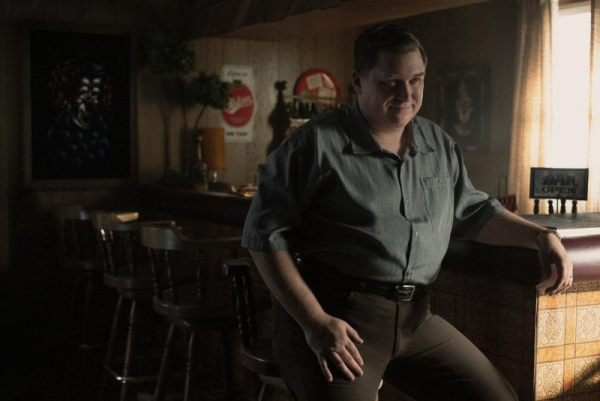
1 of 5 | Michael Chernus plays John Wayne Gacy in “Devil in Disguise,” premiering Thursday on Peacock. Photo courtesy of Peacock
Actors Michael Chernus, Marin Ireland and Gabriel Luna, as well as showrunner Patrick McManus, say they hope Devil in Disguise: John Wayne Gacy, premiering Thursday on Peacock, honors the serial killer’s victims.
Chernus, 48, plays Gacy in the dramatization of Peacock’s previous docuseries. Ireland, 46, plays Elizabeth Piest, the mother of Gacy’s final victim, 15-year-old Rob Piest.
In a recent Zoom interview with UPI, the cast agreed the real victims of Gacy were foremost on their minds. Even though it was Piest’s family that led the police to Gacy in 1978, Chernus thought about all 33 victims during filming.
“All of these young men and boys whose lives were lost became very real for me,” Chernus said. “So often we know the names of these awful serial killers but we can’t name a single victim of theirs. So I hope we start to shed some light on who some of these young men were.”
Elizabeth Piest died in 2021, but even if she were still living, Ireland said she would respect the family’s privacy.
“We were thinking of this as telling our version of this story and allowing their family some privacy that I think is much deserved,” Ireland said. “The character became a little bit of a voice for a lot of the victims’ families and that journey that they all went on together.”
McManus created other true crime series, including two seasons of Dr. Death and The Girl from Plainville. He turned down Devil in Disguise twice because he did not want to tell Gacy’s story.
Gacy was a performing clown prior to his arrest, leading many to emphasize the “Killer Clown” aspect of his story. Only upon deciding to tell the victims’ stories did McManus decide to take on the project.
McManus’ team reached out to 30 of the families of victims. Only five responded, McManus believes largely due to expired contact information.
“I wasn’t looking for a blessing when we reached out,” McManus said. “In fact, I was opening myself up genuinely for them to A, hear it from me that we were doing this, but B for them to be upset at me and for us to have an honest conversation about what we were trying to do. We won’t get it all right but we got the spirit right about who their family members were that were lost.”
The spirit of the Piest family specifically was important to Ireland.
“Even though the lines we spoke weren’t necessarily verbatim or anything, the people themselves were people we kept at the front of our minds all the time,” Ireland said. “My particular sense of purpose with the project was really linked to keeping her at the forefront of my mind and honoring her.”
The role of Gacy challenged Chernus’s drama school lessons, which taught him to have empathy for any character. Preparing for Gacy, Chernus came to the conclusion that those lessons were “a bunch of B.S.”
“You don’t have to have empathy for your character to play them,” Chernus said. “[Gacy] was a human being. He was alive. He was a real person. He was flesh and bone but that’s about as far as I could get with him. I didn’t have sympathy for him.”
Chernus said he considered Gacy a narcissist based on his verbose conversations with the detectives who investigated him. Chernus said it was hard to shake off the role but worth the challenge.
“At the end of the day, I’m proud of what we made and there was a larger purpose,” Chernus said. “Hopefully, the thing that stays with me over time is that we try to tell this story from a different angle than it’s ever been done before.”
Rafael Tovar was a real-life detective assigned to the Gacy case. The series shows how Tovar explodes during questioning as Gacy casually discusses his crimes.
Luna, 42, played Tovar in the series and understood his short fuse with Gacy.
“He was so nonchalant with everything that I think it drove Detective Tovar, just drove him mad dealing with a character like that,” Luna said. “He seemingly had this kind of freedom that other perps don’t have just because of his ability to communicate, his ability to finesse his way and ingratiate himself with certain members of the community and of law enforcement. I think he was just Tovar’s complete opposite.”
Luna also said the recreation of Gacy’s house, in which Tovar spends several scenes digging up remains of the victims, captured the creepy discoveries the real detectives made.
“There’s just the details, just the little business cards, the John Wayne Gacy business cards, the weird racing stripes that lead to his bedroom, of course the velvet clown paintings that were all adorning the walls,” Luna said. “It was a very weird, just so specific and accurate that it definitely gave me the creeps.”
Each episode concludes with photos of Gacy’s victims. McManus credits writer Yasmine Almanaseer with suggesting this.
“Those photos come up and [viewers] are reminded in the final moments that what we just watched was a story of a very real boy or a very real young man,” McManus said. “I hope that has an impact and a lasting impression on everyone more than anything we did in the previous 52 minutes. I hope that moment is cemented with them.”
There are not enough episodes to show photos of every victim, but McManus said all the victims are named in the finale. Each episode also includes links to the Regarding Youth ImpACT campaign to protect at-risk youth.
“My hope from this show is that people, instead of researching John Wayne Gacy the clown, they begin to research these young boys and young men’s lives and learn a little bit more about them,” McManus said.
